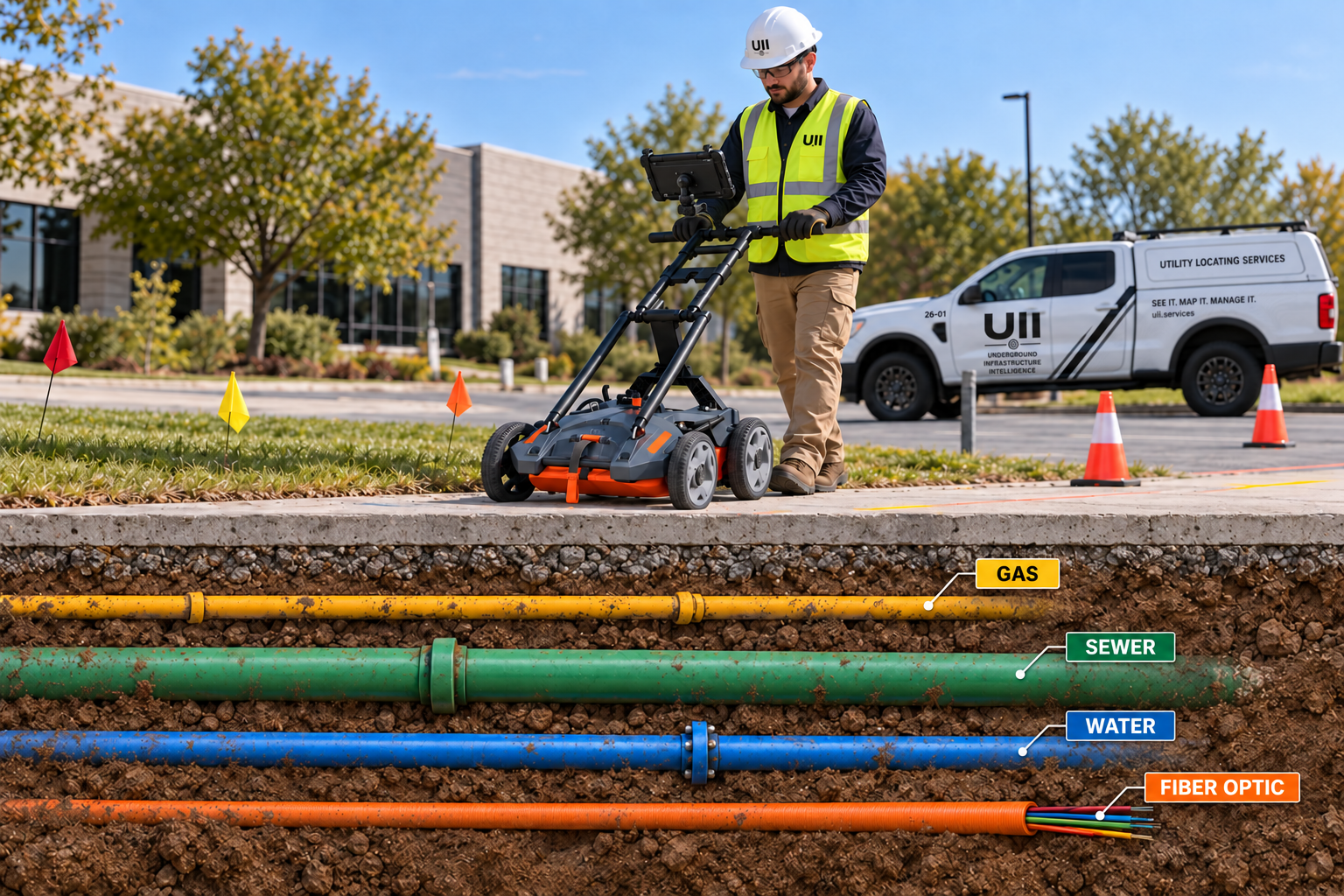
What We Mean by Intelligence
There's a difference between data and intelligence. Data is a set of marks on the ground and a stack of records that may or may not match each other. Intelligence is knowing which of those you can trust, where they disagree, and what that means for the work you're about to do on Tuesday morning.
That's the gap Underground Infrastructure Inteligence exists to close. The name isn't decoration. Underground infrastructure is the part of a site nobody can see and everybody assumes somebody else already checked. We treat the buried environment as something to be understood properly rather than guessed at, and we hand back information a crew, a designer or an owner can actually make a decision from.
Where the Guesswork Usually Starts
Most underground surprises aren't random bad luck. They come from a handful of predictable places, and once you know to look for them, a lot of the mystery goes away.
- Record drift. As-builts drawn one way, installed another, and never corrected. The paper and the ground have been slowly disagreeing for decades.
- Abandoned and unrecorded lines. Things that were taken out of service, left in place, and dropped off every map that followed.
- Depth assumptions. A line's horizontal position gets marked carefully and its depth gets assumed. Depth is usually what bites you.
- Ownership gaps. Private-side facilities past the meter or past the property line that no locate ticket covers.
- Stale information. Work done last season that hasn't made it into anyone's system yet.
None of that is exotic. It's just what happens when infrastructure gets built and rebuilt over long stretches of time by a lot of different hands. The point of gathering intelligence is to stop treating those gaps as unknowable and start treating them as questions with answers.
How the Information Gets Used
Good underground information isn't a report that sits in a folder. It changes what people do. On a design, it moves an alignment a few feet and saves a relocation. On a bid, it tells you whether to carry contingency or carry confidence. On a job site, it tells a crew where to slow down and where they can move.
The way we look at it, every piece of information should be able to answer a plain question: what changes because I now know this? If nothing changes, it wasn't worth collecting. If something does, then it's worth getting right the first time, because the cost of finding out the hard way — a struck line, a stopped crew, an outage, a phone call nobody wants to make — is never proportional to the cost of knowing in advance.
The expensive part was never finding out what's down there. The expensive part is finding out the wrong way.
That's also why we'd rather be honest about uncertainty than confident about a guess. If something can't be confirmed, saying so clearly is more useful than a clean-looking answer that quietly isn't true. People make good decisions with imperfect information as long as they know which parts are solid and which parts aren't.
Talk to a Specialist Directly
Underground Infrastructure Inteligence is run by experienced specialistsand when you call, you get one of them. No queue, no account rep reading from a script, no waiting for somebody to call you back who'll then have to ask somebody else.
We're reachable seven days a week, 7:00am to 7:00pmMonday through Sunday. That's deliberate. Underground problems don't respect business hours, and the questions that matter most tend to come up early in the morning before a crew mobilizes or late in the day when something unexpected has just turned up in a trench.
- Phone: (317) 350-4623
- Email: roger.veach@axiatp.com
- Hours: Monday through Sunday, 7:00am–7:00pm
If you've got a site with a question mark under it, call and describe it. Even a short conversation usually makes it clear what's worth chasing and what isn't — and that's a better starting point than hoping the drawings are right.